Hybrid Systems
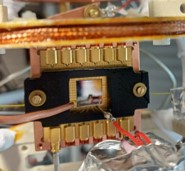 Our team combines various physical platforms into hybrid quantum systems for fundamental and applied quantum research. Quantum studies often happen in one isolated system with specific strengths, while applications require combining seemingly incompatible properties like long coherence times and strong interactions. Photons efficiently transmit quantum bits (qubits) but are unsuitable as storage devices. Atoms and ions are excellent quantum storage devices but not suitable for long-distance information transmission. Superconducting qubits allow for rapid computation but have limited coherence times. Hybrid quantum systems can compensate for the weaknesses of one system with the strengths of another.
We study the systems combining superconducting circuits with nitrogen-vacancy centers (NV centers) in diamond and alkali atoms and molecules in noble gas crystals (or cryocrystals). Impurities “trapped” inside crystals are rather easy to handle experimentally as compared to free particles. To effectively connect embedded spins and resonators, strong coupling must be achieved. In this regime, the speed at which the systems “communicate” with each other is faster than the rate at which each individual system loses information. We achieve strong coupling collectively by coupling to a high number of atoms or NV centers in a crystal.